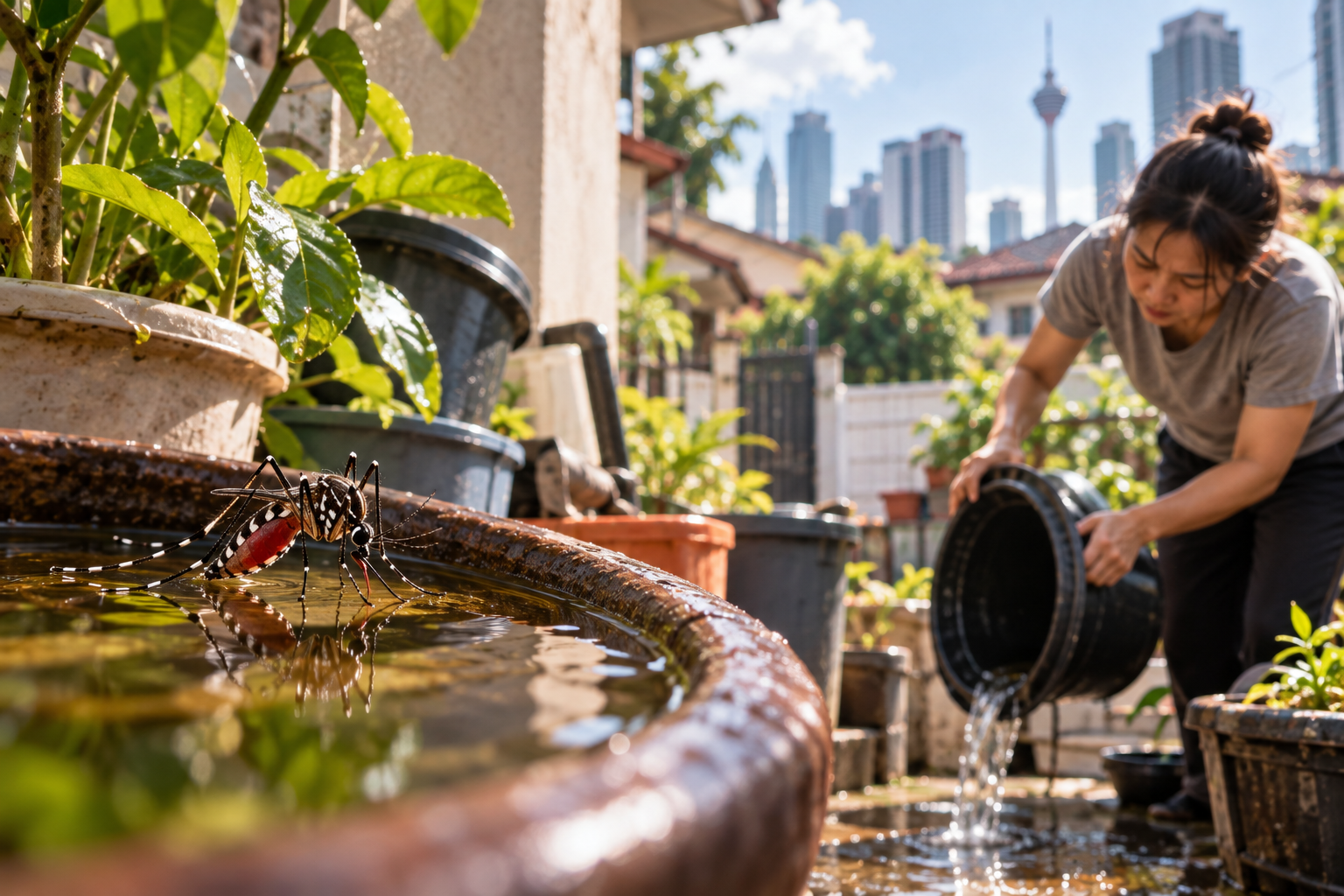
Malaysians have heard the same dengue advice for decades: remove stagnant water. Yet cases have risen sharply in 2026. The reason is more complicated than dirty flower pots.
Why it matters
Dengue is so familiar in Malaysia that we sometimes stop treating it as news. Then the numbers jump.
By Epidemiological Week 32 of 2026, Malaysia had recorded 58,079 dengue cases and 55 deaths, according to Health Ministry figures reported in August. That represented a 56.2% increase in cases compared with the corresponding period of 2025.
So why, after decades of fogging, gotong-royong campaigns and reminders about stagnant water, are we still fighting dengue?
Because dengue isn’t one simple problem.
The mosquito is extraordinarily good at living with us
The Aedes mosquito doesn’t need a dirty swamp. It can breed surprisingly close to home. A small amount of standing water in containers, drains, plant trays and discarded objects can provide breeding opportunities.
And urban Malaysia gives mosquitoes something else they need: people living close together. One infected mosquito doesn’t have to travel across a state. It just needs access to enough humans nearby.
Weather matters too
Malaysia’s combination of warmth, rainfall and humidity creates favourable conditions for mosquito reproduction. The Health Ministry has cited factors including climate conditions, urbanisation, persistent breeding sites and population movement when explaining recent increases. A change in the dominant circulating dengue virus serotype has also been identified as a contributing factor in 2026. That means dengue numbers can rise even when individual households believe they’re doing the right thing.
What about Wolbachia mosquitoes?
This is where dengue control gets interesting. Malaysia has deployed mosquitoes carrying Wolbachia, a naturally occurring bacterium that can reduce the ability of mosquitoes to transmit dengue viruses. Instead of simply trying to kill every mosquito, the strategy aims to make mosquito populations less effective at spreading disease.
It doesn’t mean household prevention suddenly becomes unnecessary.
But it illustrates something important: Dengue control increasingly involves biology, urban planning, surveillance and community behaviour at the same time.
And now there’s a vaccine
Malaysia also has access to a registered dengue vaccine through private healthcare facilities, while the Health Ministry has been evaluating whether a dengue vaccine should eventually become part of the National Immunisation Programme.
As of August 2026, however, the ministry said it was still conducting studies and a cost-benefit analysis. So vaccination shouldn’t yet be interpreted as a replacement for mosquito control.
What can ordinary Malaysians actually do?
The boring advice remains important: eliminate standing water, check containers and drains, and take mosquito precautions. But there’s another lesson. Dengue isn’t simply a problem caused by a careless neighbour who forgot to empty a flower pot. It’s an ecological and public-health problem involving mosquitoes, viruses, weather, human movement and dense urban environments.
Which is why Malaysia hasn’t been able to fog its way out of dengue.
ET takeaway: Fighting dengue requires individual action but expecting individuals alone to solve it was never going to be enough.