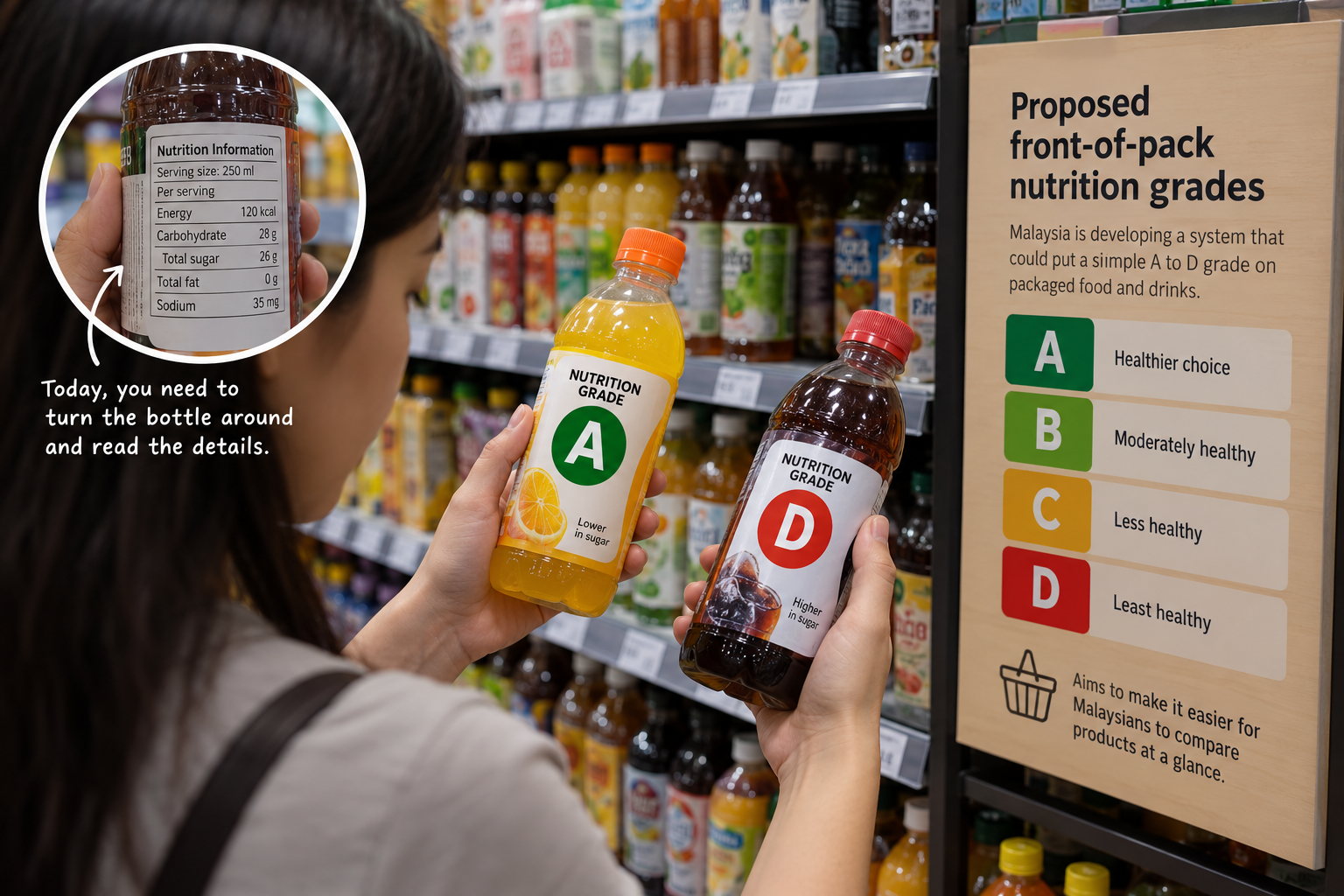
The Health Ministry is working on a front-of-pack nutrition system that could grade packaged food and drinks from A to D, with A representing healthier choices and D the least healthy. An official says it could be introduced by the end of 2026. But it remains a proposal under development, not a rule already operating in supermarkets.
Why it matters: Malaysians currently need to interpret sugar, salt and fat information themselves. A simple front-of-pack grade could make comparison easier — and pressure manufacturers to reformulate products.
Imagine standing in a supermarket comparing two drinks.
Today you may need to turn both bottles around and read: sugar, fat, calories and serving size. Malaysia wants to make that decision simpler.
The Health Ministry is developing a system that could put a large:
A, B, C or D nutrition grade on packaged food and drinks.
What would the letters mean?
Broadly: A = healthier through to: D = least healthy.
The precise Malaysian scoring rules have not yet been finalised publicly.
So ET would not assume Malaysia will copy Singapore’s system exactly.
Isn’t there already a healthier-food logo?
Yes.
Malaysia already has the voluntary: Healthier Choice Logo. As of October 2025, 1,002 products had received that recognition. The proposed grading approach would be much easier to compare at a glance.
Why could this change manufacturers rather than just shoppers?
Suppose your drink receives: D.
And the competing drink gets: B.
Suddenly there is a commercial reason to reduce: sugar, salt or saturated fat. Health Ministry official Dr Yap Wei Aun says that industry reformulation is one of the intended effects.
ET TAKEAWAY
Nutrition labels normally ask consumers to become better mathematicians.
A grading system tries something different: make the healthier choice easier to see.
But the detail matters enormously. Malaysia still needs to decide exactly: how foods are scored,
which products must display the grade, and whether advertising restrictions will accompany the system. Until those rules are announced, this remains: a promising proposal — not yet a supermarket reality.