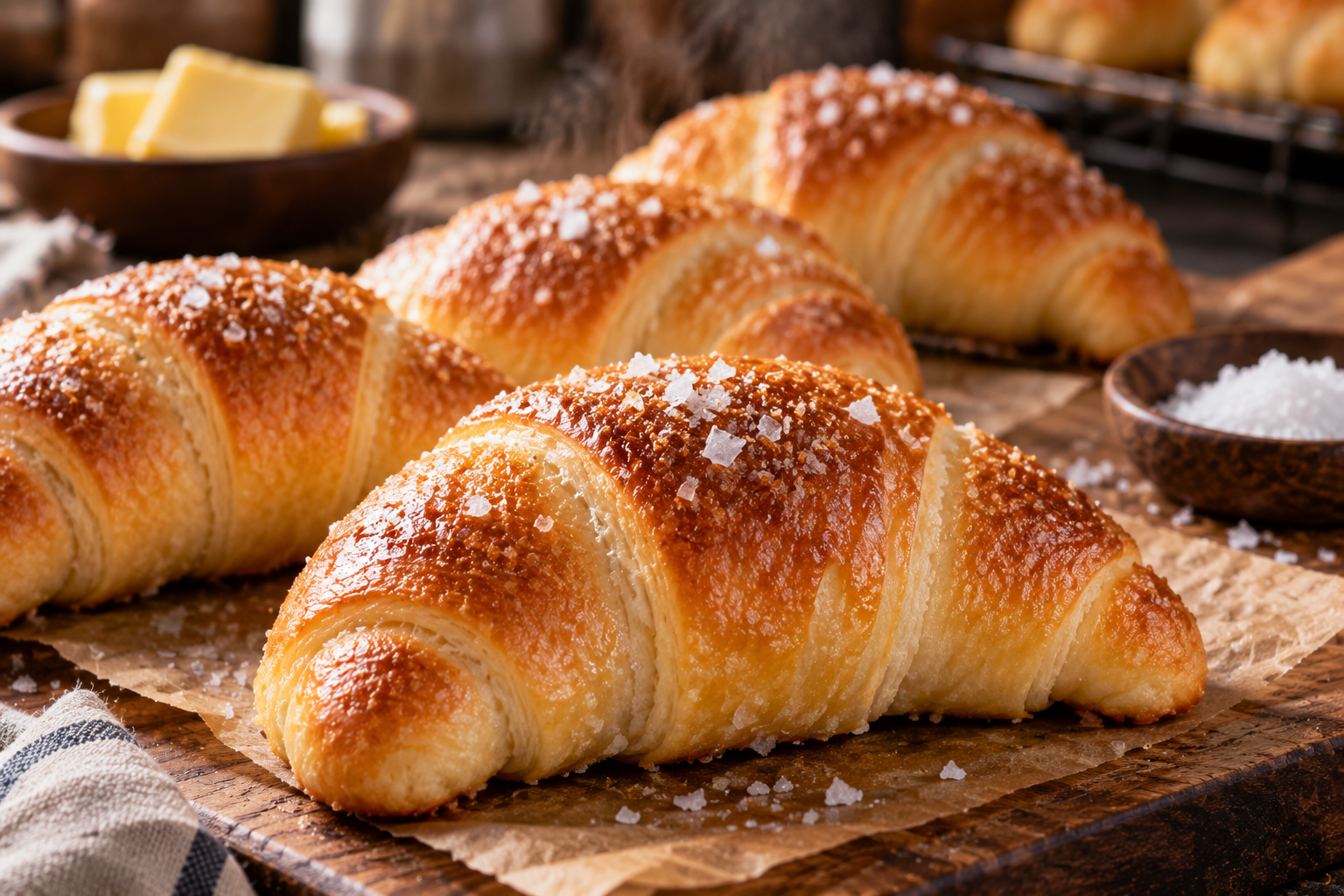
It looks like a very ordinary bread roll. No dramatic filling. No towering cream. Sometimes just butter and a few flakes of salt. Yet Shio pan has quietly become one of Malaysia’s hottest bakery obsessions. So what makes this little bread worth queueing for?
Walk into enough bakeries around KL and Selangor lately and you’ll probably notice it.
A small, crescent-shaped roll sitting innocently beside the croissants.
Shio pan.
At some bakeries, trays disappear almost as quickly as they come out of the oven. A bakery in Shah Alam, for example, attracted long queues after its version went viral, with customers reportedly travelling from as far as Johor Bahru and Ipoh.
And it’s far from alone. Local lifestyle publications have spent 2026 hunting down Shio pan across KL and PJ, while bakeries are increasingly producing their own interpretations.
So what exactly are Malaysians queueing for?
First things first: what is Shio pan?
Shio pan (塩パン) literally means “salt bread” in Japanese.
Despite its slightly croissant-like shape, it originated in Japan and is also enormously popular in South Korea, where salt bread is known as sogeum-ppang. Its ingredient list doesn’t sound particularly revolutionary.
Bread dough.
Butter.
Salt.
That’s more or less the point. A piece of butter is rolled inside the dough before baking. As the bread heats up, the butter melts, helping create an airy interior while some of it reaches the bottom of the roll.
The result, when done well?
Soft and slightly chewy inside. Golden and crisp underneath. Buttery, salty and surprisingly light.
And that crispy bottom may be the part that converts you.
Why now?
Shio pan has been riding a much larger Asian bakery trend.
It became a café favourite in South Korea before increasingly appearing across Malaysian social-media feeds and bakery counters. Local bakeries have since taken the basic formula and started playing with it. You’ll now find versions with cheese, garlic and other flavours alongside the classic salted-butter roll. But perhaps the biggest reason for its popularity is much simpler. Shio pan isn’t trying too hard.
After years of croissants stuffed with everything imaginable and desserts designed partly for the camera, there’s something strangely satisfying about a bread whose entire appeal comes down to whether the baker got the dough, butter, salt and texture right. And that’s also why a good one is harder to make than it looks.
There’s nowhere for mediocre bread to hide.
Is it worth the hype?
That depends on what you’re expecting. If you’re waiting for an explosion of pistachio cream or molten chocolate, Shio pan may leave you wondering what all the fuss is about.
But eat a really good one while it’s still warm and suddenly you understand.
There’s the little crunch underneath. Then the soft bread. Then butter. Then just enough salt to make you reach for another bite.
That’s it.
And perhaps that’s exactly why Malaysians are falling for it.
In a food world constantly trying to give us more, Shio pan became popular by giving us less and getting the simple things right.
ET takeaway
Next time you see people queueing outside a bakery for what appears to be a very ordinary bread roll, now you know. They’re probably waiting for the next tray of Shio pan.
And yes — eating it warm matters.