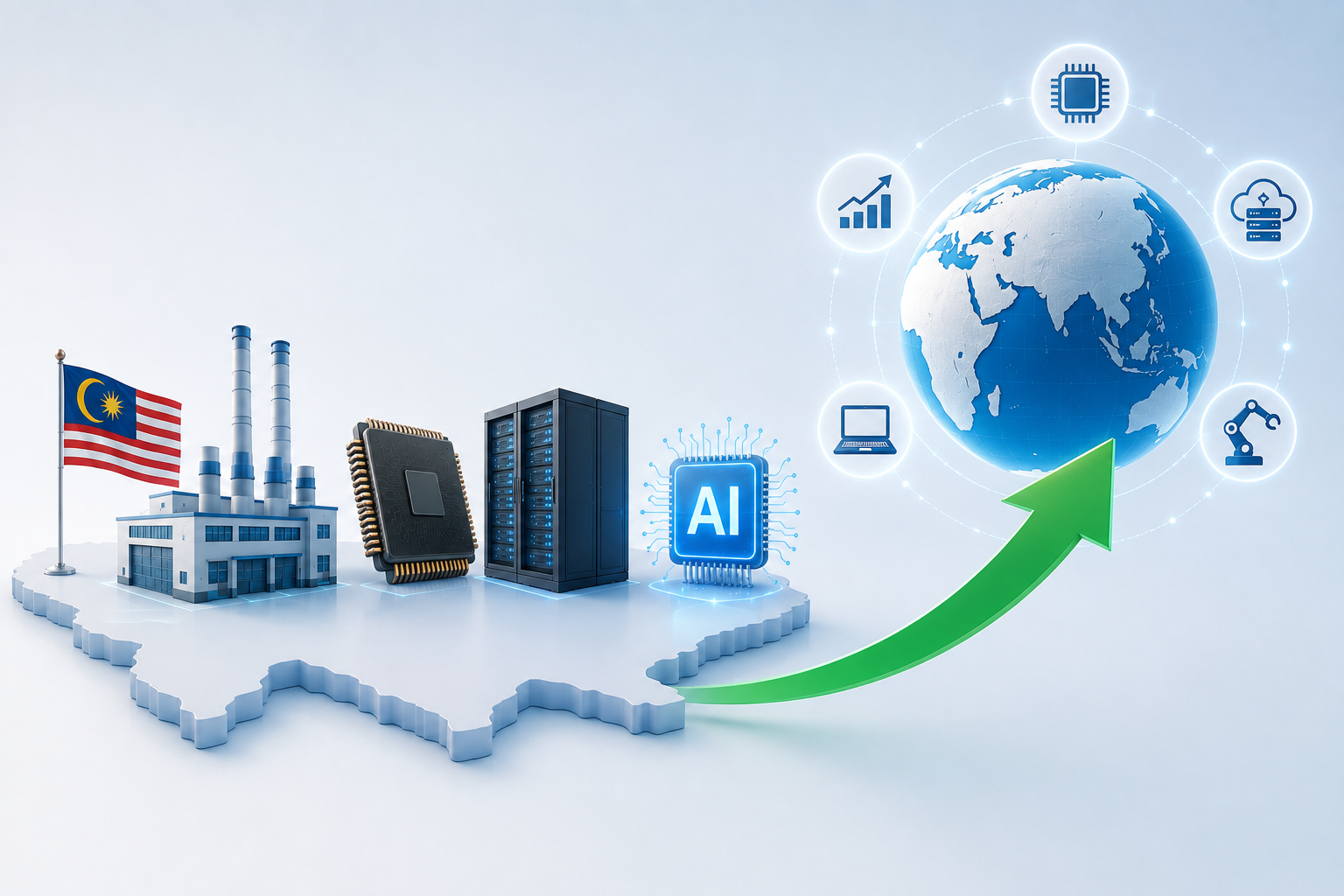
Malaysia is attracting factories, semiconductor companies, data centres and AI investment. The next challenge is harder: creating Malaysian technology that the rest of the world wants to buy.
Malaysia’s technology story is changing.
For decades, the country has been an important part of the global electronics manufacturing supply chain.
Today, the opportunity is expanding.
Semiconductors.
Data centres.
Cloud computing.
AI.
Digital content.
Malaysia is increasingly connected to all of them.
But there is a difference between:
Making technology and owning technology.
That distinction could determine how much Malaysia ultimately gains from the current boom.
Malaysia is already important to global technology
Malaysia has spent decades developing expertise in electrical and electronics manufacturing.
Today it is one of the world’s significant semiconductor exporters and plays an important role particularly in chip packaging, assembly and testing.
More recently, Malaysia — particularly Johor — has attracted enormous interest from global data-centre operators.
That’s good.
But Malaysia doesn’t want to remain only the place where other countries’ technology is manufactured or hosted.
Imagine two Malaysian companies
Company A manufactures a component designed by an overseas technology company.
It earns a margin for manufacturing it.
Company B invents its own technology.
It patents it. Builds software around it. Creates a brand. Then sells it around the world.
Both companies create economic activity.
But Company B potentially captures much more long-term value because it owns the intellectual property.
That’s why governments talk so much about innovation.
Malaysia already has creative intellectual property
Technology isn’t only semiconductors.
Malaysia’s digital creative industry has generated RM92.5 billion in revenue and RM12.1 billion in exports, according to figures highlighted by Malaysia’s digital-development ecosystem.
Animation, games and digital content are increasingly part of the discussion.
Sarawak, for example, is now trying to develop itself as a regional animation and gaming hub, supported by federal digital agencies and programmes aimed at connecting local creators to international markets.
Why does that matter?
Because a Malaysian character, game, software product or technology platform can potentially be sold repeatedly around the world.
The value doesn’t come only from producing something.
It comes from owning the idea.
What would a Malaysian tech champion look like?
It doesn’t necessarily have to become the next Google.
It could be: a cybersecurity company serving Southeast Asia, a logistics AI platform, a semiconductor-design company, a fintech company, a Malaysian game studio, an agricultural technology company, or software solving problems unique to emerging Asian markets.
Start in Malaysia. Solve a real problem. Then export the solution.
This is already entering government policy
The Ministry of Finance’s Budget 2027 priorities specifically talk about creating more competitive home-grown entrepreneurs and “Made by Malaysia” companies.
The focus includes helping start-ups and mid-sized businesses grow and reach international markets.
That wording is significant.
Malaysia isn’t simply asking:
“How much foreign investment can we attract?”
Increasingly, it is also asking:
“What Malaysian companies can we create?”
ET TAKEAWAY
Foreign technology investment is valuable.
Factories matter. Data centres matter. But Malaysia’s biggest long-term opportunity is moving from:
Made in Malaysia towards:
Invented in Malaysia. Owned in Malaysia. Sold to the world.
That’s when a technology boom becomes something much bigger.